AI Startup Funding 2026: $255B in Q1, 67% to 3 Firms
AI startups raised $255.5B in Q1 2026 — but 67% went to 3 companies. The full breakdown of where the other $83B flowed and what it means.
By Abhijit
Home
AI startups raised $255.5B in Q1 2026 — but 67% went to 3 companies. The full breakdown of where the other $83B flowed and what it means.
By Abhijit
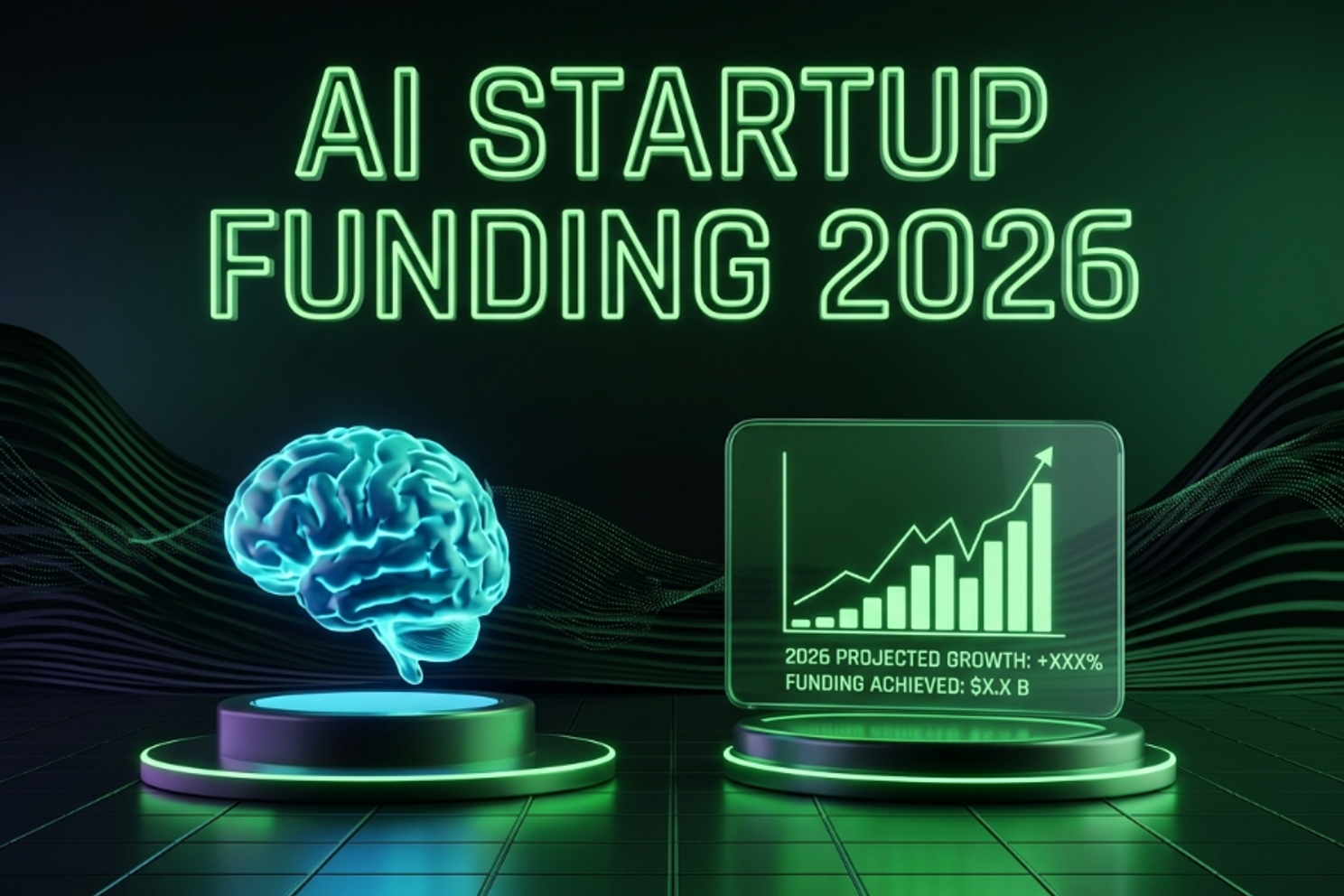
AI startup funding hit $255.5B in Q1 2026 alone — more than every dollar deployed in 2025 combined — but three companies (OpenAI, Anthropic, xAI) absorbed 67.3% of it. The remaining 1,543 deals split just $83.5B, U.S.-HQ firms captured 88% of global AI capital, and sovereign wealth funds plus hyperscalers are now writing the checks traditional venture capital cannot. The next 12 months decide whether this is the new structure of AI investment — or the peak of a concentration cycle that finally cracks.
This is the story of a market that broke its own scoreboard in 90 days. We map the megarounds, dissect why three names ate the table, follow the long-tail $83B that nobody else covers, and explain why national security capital is now the marginal AI investor.
Q1 2026 AI funding: A single-quarter deployment of $255.5 billion into AI startups globally — exceeding cumulative 2025 AI investment — driven by three megarounds totaling $172 billion and U.S.-domiciled companies absorbing 88% of all capital.
The trajectory underneath is even sharper. Foundational AI funding ran at $1.4B in 2022, $23.2B in 2023, $211B in 2025 — and a single quarter of 2026 already exceeds that 2025 print. The compound annual growth on that curve is not a market trend. It is a structural reordering of where private capital goes.
The Gridpulse leaderboard, ranked by disclosed round size:
Ranks 1–3 are the structural story. Ranks 4–10 are where the long-tail capital actually expresses an investment thesis — and the part of the table the rest of the financial press is ignoring.
The concentration is not irrational exuberance — it is the only logical move once you accept four assumptions about how foundation models monetize.
LLM economics now resemble cloud infrastructure more than they resemble software. Switching costs compound (fine-tuned models, integrated agents, enterprise data residency), distribution flywheels accelerate (ChatGPT consumer + API + enterprise), and inference cost curves keep falling. Whoever crosses the user-base inflection first compounds advantages no challenger can buy back at any price.
Training a frontier model now costs more than building a hyperscale data center used to. Anthropic's reported $47B run-rate at a $965B valuation does not look insane to growth investors — it looks like an industrial business with software margins. Only firms that have demonstrably absorbed billions in compute, talent, and governance overhead can credibly accept another $50B+ check.
Sovereign wealth funds, hyperscaler treasuries, and the largest pensions need single-position checks measured in tens of billions. Spreading the same capital across 50 mid-stage AI startups creates portfolio overhead they are not built to absorb. Megarounds are the only product that fits the buyer.
When a hyperscaler or sovereign writes a $20B check into a frontier lab, it is not a financial bet. It is a national-tech alignment statement — and the price is whatever protects the strategic seat at the table. The "valuation" line on the term sheet is a residual, not a target.
This is the part of the AI startup funding story that gets buried under megaround headlines. Across 1,543 disclosed deals, the long-tail capital sorted into five clean buckets — and each one has a different risk-return profile from the top of the table.
Three patterns repeat across the long tail. First, revenue clarity beats narrative. Vertical AI in regulated industries (healthcare, finance, defense) closes rounds at lower multiples but on shorter paths to ARR. Second, infrastructure rewards picks-and-shovels. Anyone reducing inference cost-per-token captures a structural toll on the entire AI economy, regardless of which foundation model wins. Third, AI ops is the durable middleware play — every enterprise deploying AI needs evals, observability, and governance, and the budget for that stack is being established in 2026.
The Forbes AI 50 list captures the visible end of this group; Crunchbase data confirms that even outside the megarounds, U.S. companies are taking the disproportionate share — but the international long tail is where local champions get built before global flows reach them.
The Gridpulse Brief — A weekly breakdown of every AI funding round above $50M, the strategic backer behind it, and the long-tail thesis it implies. Join the readers tracking AI capital flows that hyperscalers and sovereign funds move every week. → Subscribe here
The marginal AI investor in 2026 is not a venture fund. It is a sovereign wealth office, a hyperscaler treasury, or a national strategic-tech program — entities with balance sheets measured in trillions and a policy mandate alongside the IRR target.
A traditional $5B venture fund cannot underwrite a single $20B check without breaking concentration rules, LP commitments, and reserve math. Even tier-1 funds with growth vehicles top out where megarounds begin. The capital structure of venture capital was not designed for assets that need $50B+ to clear the next milestone — so a different class of investor took the seat.
Founders taking sovereign or hyperscaler capital trade dilution for distribution — and traditional control terms for strategic alignment. The capital is genuinely cheaper than venture money, but the governance bill is paid in optionality: exit constraints, geographic restrictions, dual-use review, and partnership obligations that VC term sheets never contained.
When sovereign capital shapes which AI companies dominate, the underlying question is no longer "who builds AGI" — it is "whose AGI is it." Cross-border investment review (CFIUS in the U.S., parallel frameworks in the EU and Asia) is now a gating factor on every megaround. Founders who ignore this lose six months of fundraising timeline when reviews stall.
Q1 2026 did not just break the funding record — it redrew the map of who builds AI and who buys the result. Three names absorbed two-thirds of global AI capital, sovereign and hyperscaler money replaced the venture vehicle that used to set the price, and the long-tail $83B is now the only part of the market where traditional investment logic still applies. The market is not irrational. It is consolidating, and consolidations end one of two ways: a regulatory reset that forces decentralization, or a winner-take-most outcome that locks in for a decade. Either path reprices every AI position on the table — including the ones already at $965B.
The question for the next 12 months is no longer "how much AI funding is too much." It is: who gets to write the checks the venture industry can no longer underwrite — and what do they want in return?

Most business plans fail because founders write for the wrong reader. Use the Two-Audience Plan framework to build one investors fund and operators run.
A repo-backed walkthrough of the skills serious teams install in Claude Code for web development, design, and cross-platform apps.
Get weekly curations of the best articles, resources, and insights directly to your inbox about AI, Tech, Finance & Business.