GLM-5.2 Review: Z.ai's 1M-Context Bet, No Proof
Z.ai shipped GLM-5.2 with a 1M-token context window and zero benchmarks. Here's what's confirmed, what's hype, and whether to switch today.
By Abhijit
Home
Z.ai shipped GLM-5.2 with a 1M-token context window and zero benchmarks. Here's what's confirmed, what's hype, and whether to switch today.
By Abhijit
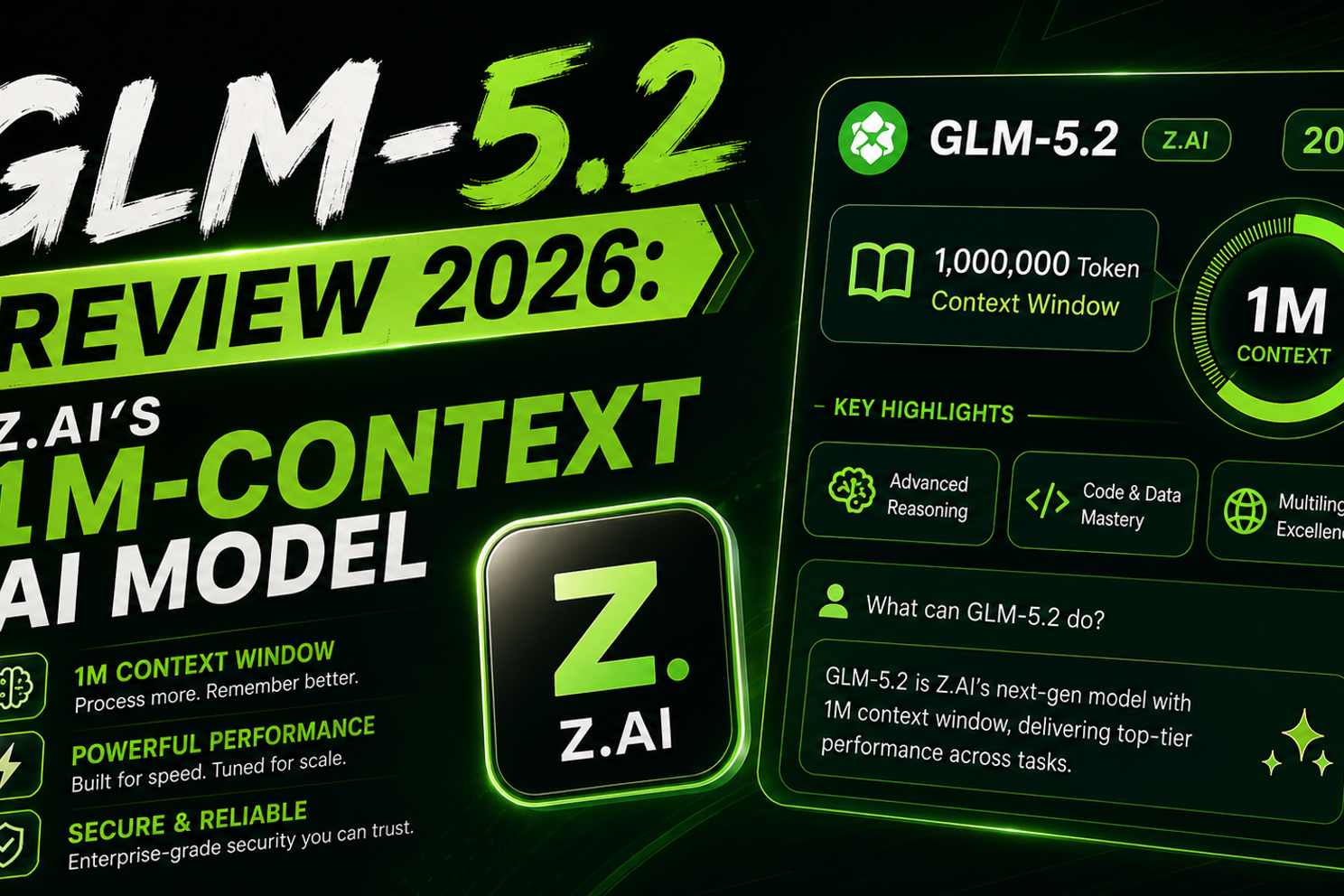
Z.ai shipped GLM-5.2 on June 13, 2026, with a 1-million-token context window, two new reasoning-effort modes, and exactly zero benchmark scores. The model is live today for every GLM Coding Plan subscriber; open weights under MIT, standalone API access, and a chatbot at chat.z.ai are promised "next week." GLM-5.2 is the fourth flagship-tier release from Z.ai in four months — and the first one that asks you to trust the trajectory instead of reading the scoreboard.
That gap between spec sheet and evidence is the story here. GLM-5.1 earned a credible third place on Code Arena and edged past Claude Opus 4.6 on SWE-bench Pro. GLM-5.2 inherits that momentum plus a 5x context expansion — but inheritance is not proof, and a model launch without a technical report is a marketing event until the numbers land.
GLM-5.2: Z.ai's third major iteration of the GLM-5 family — a 744-billion-parameter Mixture-of-Experts model with 40 billion active parameters per token, now shipping with a 1,000,000-token context window and dual thinking-effort levels (High and Max) for agentic coding work.
Z.ai is the international brand of Zhipu AI, a Beijing-based foundation model company spun out of Tsinghua University in 2019. The company completed a Hong Kong Stock Exchange IPO on January 8, 2026, raising roughly USD 558 million at a market cap near USD 52.83 billion under CEO Zhang Peng. That capital funded four flagship releases in under five months:
GLM-5.2 reads as a focused upgrade, not a ground-up rebuild. Same architecture, same DeepSeek Sparse Attention for long-context inference, refined post-training — with the context expansion and effort-level system bolted on top. It sits alongside GLM-5V-Turbo, the multimodal vision-coding variant launched April 1 with its own 200K window, though whether GLM-5.2 inherits any vision capabilities has not been confirmed.
GLM-5.2's standout spec — explicitly labeled glm-5.2[1m] in Z.ai's own configuration — pairs a 1,000,000-token input window with up to 131,072 output tokens per response. That is a 5x jump from GLM-5.1's 200K ceiling.
In concrete terms: a coding agent running GLM-5.2 can hold an entire mid-sized repository — source files, tests, configs, and a long conversation history — in working memory without the constant summarization and context re-fetching that smaller windows force. Z.ai's own setup instructions set the auto-compact threshold to 1,000,000, which tells the agent to stop compressing history early.
The release also introduces two thinking-effort levels — High and Max — replacing GLM-5.1's single reasoning mode. Z.ai's guidance is blunt: use Max for coding. In Claude Code, the /effort command at xhigh, max, or ultracode all route to GLM-5.2's Max mode.
Here is the question Z.ai has not answered: does GLM-5.2 maintain accuracy across the full million tokens? Long-context models have historically suffered from attention degradation — the model holds the tokens but stops using them reliably past a certain depth. Google's Gemini 1.5 Pro demonstrated usable million-token retrieval; most competitors have not. Until independent needle-in-a-haystack or long-context coding benchmarks confirm GLM-5.2's effective window, the 1M number is a capacity claim, not a performance claim.
GLM-5.2 dropped with immediate access for every GLM Coding Plan subscriber — Lite, Pro, Max, and Team tiers, no waitlist. That part works now.
Everything else is staggered:
If GLM-5.1's rollout is any guide, "next week" from Z.ai historically means one to two weeks. The gap between GLM-5.1's API launch and its open-weight release ran roughly 11 days.
Early sentiment tracked at approximately 91% positive — developers are genuinely excited about the context window and the MIT commitment. The 9% negative raised two consistent objections: an "open" model launching exclusively behind a paid subscription feels contradictory, and a flagship with a headline spec bump and zero benchmarks looks rushed. Both criticisms are fair and worth holding in mind through the rest of this review.
The search query "GLM-5.2 vs GPT-5" is already outdated by the time someone types it. OpenAI shipped four GPT-5-series updates since GPT-5.2 launched in December 2025. The real opponent is GPT-5.5 (April 2026), not a six-month-old snapshot.
GLM-5's original technical report showed it beating GPT-5.2 on SWE-bench Multilingual back in February, before two further iterations. GLM-5.1 narrowly led GPT-5.4 on SWE-bench Pro (58.4 vs 57.7). But GPT-5.5 currently dominates agentic terminal work at 82.7% on Terminal-Bench 2.0 — a benchmark where no GLM-5 family score has been published.
The honest read: GLM-5.2's job is to hold or extend GLM-5.1's lead against GPT-5.5, not to beat a retired model. Without GLM-5.2-specific numbers, any "GLM-5.2 beats GPT-5" claim online is extrapolation, not data.
GLM-5.1 was already remarkably close to Claude's flagship. It sat third on Code Arena at 1530 Elo — behind only Claude Opus 4.6 Thinking (1548) and Claude Opus 4.6 (1542) — and its 58.4 on SWE-bench Pro actually edged past Claude Opus 4.6's 57.3.
GLM-5.2's two biggest upgrades — the 5x context jump and the Max-effort reasoning mode — target exactly where Claude has historically held its edge: large-codebase comprehension and sustained multi-step reasoning across long sessions. Z.ai is aiming at the right gap.
What cannot be said yet is whether GLM-5.2 closes that gap. Z.ai published no technical report or benchmark table for GLM-5.2 specifically. Everything above describes GLM-5.1's confirmed standing; GLM-5.2 inherits the trajectory but has not proven the destination.
This is where intellectual honesty matters most. As of this review, Z.ai has published zero official benchmark scores for GLM-5.2. The launch announcement covered availability, the context window, and the open-source roadmap — not a single SWE-bench, Terminal-Bench, or Code Arena number.
The KingBench results that circulate in GLM-5 discussions measured the original GLM-5 in February 2026, not GLM-5.2. That testing placed GLM-5 first on the KingBench Agent Leaderboard and third on the private coding benchmark, reportedly ahead of Claude Opus 4.6 on agentic tasks. Those results are real — but they are three iterations and four months old.
I'll call this what it is: The Benchmark-Free Launch Pattern — shipping a flagship model with a headline spec increase and zero accompanying performance data. It is a marketing-first move. Z.ai earned real credibility with GLM-5.1's verified numbers, but credibility is not a substitute for evidence. Until SWE-bench Verified, SWE-bench Pro, Terminal-Bench 2.0, and Code Arena results land for GLM-5.2 specifically, every "GLM-5.2 beats X" claim is projection, not proof.
GLM-5.2 drops into the coding agents you already use — no separate app beyond a GLM Coding Plan subscription.
Claude Code — open settings.json and update:
{
"env": {
"CLAUDE_CODE_AUTO_COMPACT_WINDOW": "1000000",
"ANTHROPIC_DEFAULT_HAIKU_MODEL": "glm-4.5-air",
"ANTHROPIC_DEFAULT_SONNET_MODEL": "glm-5.2[1m]",
"ANTHROPIC_DEFAULT_OPUS_MODEL": "glm-5.2[1m]"
}
}
Run /effort and switch to max. Use /status to confirm GLM-5.2 is active.
OpenClaw — add a glm-5.2 entry to models.providers.zai.models with a context window of 1,000,000 and max tokens of 131,072. Point agents.defaults.model.primary at zai/glm-5.2 and restart the gateway.
Cline — select the OpenAI Compatible provider, set the base URL to Z.ai's coding API endpoint, choose custom model glm-5.2, and set the context window to 1,000,000 manually.
The Gridpulse Brief — A clean breakdown of which new AI models actually earn their API costs and which ones ship hype instead of benchmarks. Join readers who test before they trust. → Subscribe here
GLM-5.2 is worth testing today if you already subscribe to a GLM Coding Plan and regularly hit context limits in long agentic sessions. It is not worth rebuilding your stack around — because the data needed to justify that decision does not exist yet.
The real test is not whether GLM-5.2 can hold 1 million tokens. It is whether it can use them productively across a full agentic session without the accuracy degradation that has plagued every long-context model before it. Z.ai has earned the right to be taken seriously — four flagship releases in four months, GLM-5.1's verified third-place standing on Code Arena, and a genuine MIT commitment. But earning the right to be taken seriously is not the same as earning the right to be trusted without evidence.
The technical report and independent benchmarks will determine whether GLM-5.2 is the model that finally makes a Chinese lab the undisputed coding-agent leader — or just another spec-sheet upgrade that ships the press release before the proof. We will update [INTERNAL LINK PLACEHOLDER: suggest post on best AI models leaderboard] the moment verified numbers land.

Early research on AI and cognition suggests offloading to chatbots can weaken recall, persistence, and problem-solving. One MIT study found essay writers using gen AI performed worse over time.

Xbox loses 64 cents on every dollar and just cut 3,200 jobs. Here's why even the biggest game launch in history can't fix gaming's broken economics.

Google's Gemini Omni Flash generates and edits video in conversation at $0.10/second. Here's what the API actually delivers — and where 720p hits a wall.

Anthropic's 11 Cowork plugins erased a real margin pool overnight. The mechanism, the casualty list, and what it does to Indian IT services next.

Two free skills, one reference folder, and the exact prompts I used to ship a $10K-tier animated portfolio in Claude Code. No agency, no boilerplate.
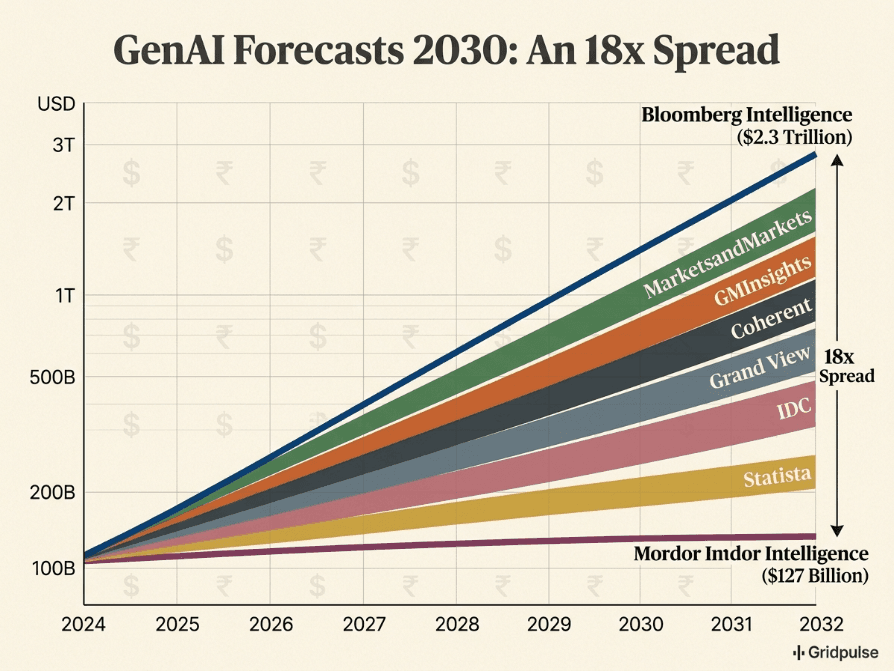
Bloomberg sees $2.3T. Mordor sees $127B. The same market, the same year — here's why every generative AI forecast through 2030 is fighting a different war.
Get weekly curations of the best articles, resources, and insights directly to your inbox about AI, Tech, Finance & Business.