Blue Origin Moon Lander Clears NASA Vacuum Test, Eyes 2026 Launch
Blue Origin's Endurance MK1 moon lander clears NASA's thermal vacuum chamber test, targeting a late-2026 lunar South Pole delivery ahead of Artemis.
By Abhijit
Home
Blue Origin's Endurance MK1 moon lander clears NASA's thermal vacuum chamber test, targeting a late-2026 lunar South Pole delivery ahead of Artemis.
By Abhijit
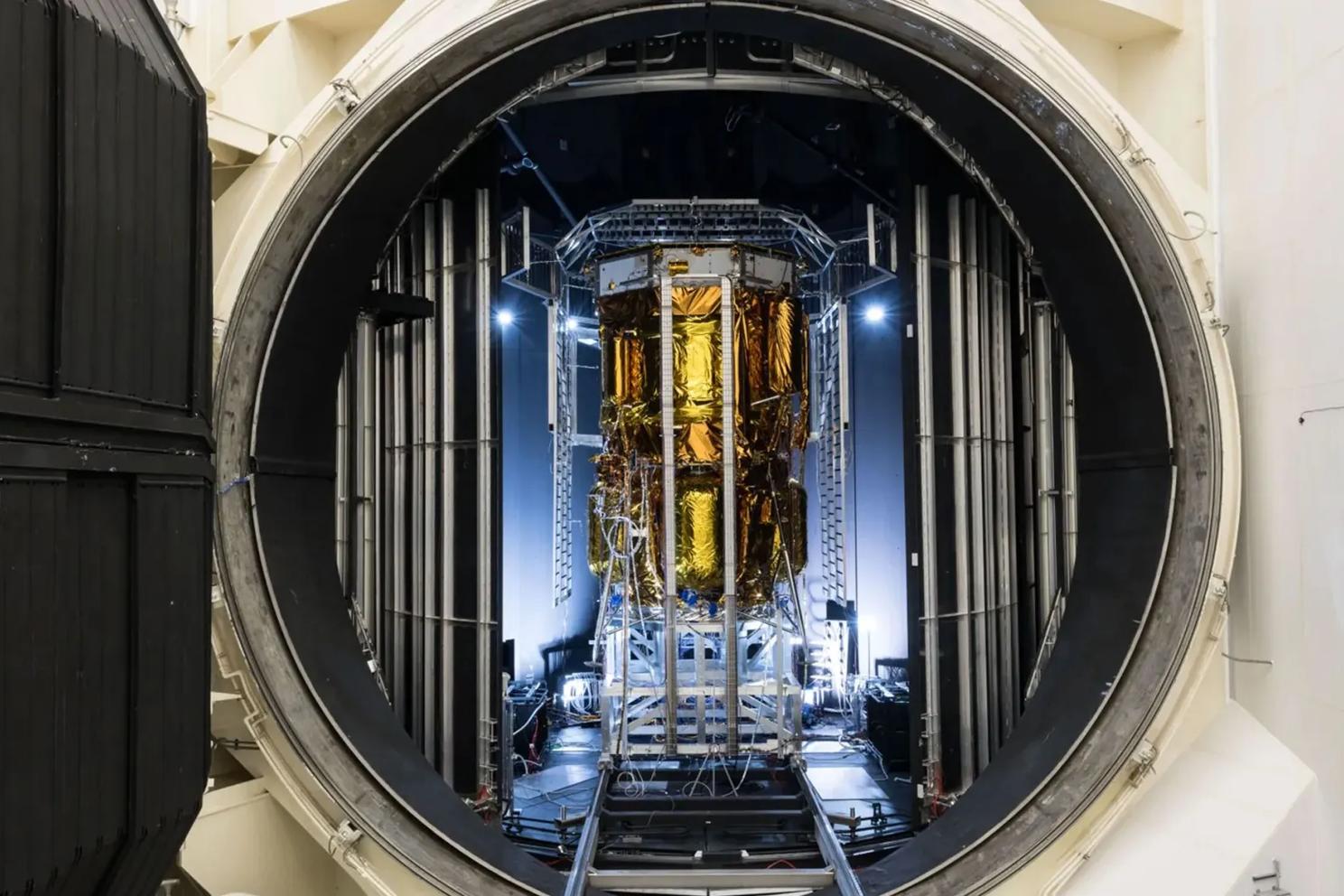
Blue Origin's Endurance lunar lander — the uncrewed cargo spacecraft also known as Blue Moon MK1 — has passed critical thermal vacuum testing at NASA's Johnson Space Center, clearing a major milestone on its path to a late-2026 moon mission.
This is not a routine engineering update. Every successful test on a lunar lander brings NASA's Artemis programme one step closer to putting humans back on the Moon — and it intensifies a genuine two-horse race between Blue Origin and SpaceX for dominance in lunar infrastructure. For anyone watching the future of space, the next 18 months just got more interesting.
NASA's Johnson Space Center houses Chamber A, one of the largest thermal vacuum chambers in the world. Engineers subjected Endurance to the brutal temperature swings and near-zero pressure it will face in actual space — and it held up. The test validates the spacecraft's structural integrity and propulsion systems ahead of its Pathfinder Mission 1 launch on New Glenn NG-4, currently targeted for late 2026.
Endurance is not flying empty. It carries two specific science payloads under NASA's Commercial Lunar Payload Services programme, known as CLPS. The first is a set of Stereo Cameras designed to study how rocket plumes interact with the lunar surface during descent — data that is directly relevant to making future crewed landings safer. The second is a Laser Retroreflective Array, a precision positioning tool that supports accurate navigation near the lunar South Pole.
The lander is designed to carry up to 3 tonnes of cargo and will launch from Cape Canaveral's LC-36A pad aboard New Glenn, Blue Origin's heavy-lift rocket.
Blue Origin has been building toward this moment for years. The company lost a high-profile legal battle against NASA in 2021 after being shut out of the initial Human Landing System contract that went to SpaceX. Rather than retreating, Blue Origin repositioned itself strategically — competing through NASA's CLPS programme for uncrewed cargo deliveries while simultaneously securing a separate HLS contract for the larger MK2 variant, worth $3.4 billion, targeting Artemis V.
The thermal vacuum test happened at a NASA facility — not a private Blue Origin lab. That matters. Access to NASA's world-class testing infrastructure accelerates the development timelines of private space companies in ways that are hard to replicate with in-house facilities alone. It is a partnership model that reduces development risk on both sides: NASA gets a tested, verified spacecraft and Blue Origin gets credibility and data it could not generate independently.
New Glenn's recent record complicates the picture somewhat. The rocket suffered a setback in April 2026 when a satellite failed to reach its intended orbit. But New Glenn had logged successful flights before that, including a booster recovery, and the programme is continuing. The April failure is a data point worth watching — not a reason to write off the 2026 launch timeline yet.
Here is what most coverage of this story gets wrong: the framing is almost always about whether Blue Origin can "catch up" to SpaceX. That framing misses what is actually happening.
MK1 is an uncrewed cargo lander. It has a simpler mission profile than Starship, a faster development path, and a narrower set of technical requirements. If Endurance lands successfully on the lunar South Pole in late 2026, Blue Origin becomes the first private company to deliver cargo to the Moon. That is not a consolation prize. That is a legitimacy milestone that changes how NASA, investors, and the broader aerospace industry think about Blue Origin as an operator — not just a manufacturer.
SpaceX's Starship is the more ambitious machine, capable of carrying crew and vastly more mass. But Starship's complexity is also its vulnerability. Flight 12 is still being prepared as of early 2026, and the programme has seen both breakthroughs and explosions. Artemis III — the crewed lunar landing — has already slipped to 2028. That timeline gives MK1 a real window.
The CLPS plume-surface payload is worth a second look for a non-obvious reason. The data it collects about how rocket exhaust disturbs lunar regolith during descent will directly inform the safety protocols for crewed landings. It is basic science doing heavy lifting for human safety. That link rarely gets mentioned.
For India, the relevance is more indirect but real. ISRO's Chandrayaan-3 landing near the lunar South Pole in 2023 made India one of only four countries to achieve a soft lunar landing. The South Pole is now the most contested piece of real estate in the solar system, because that is where water ice is believed to exist. Every private lander that succeeds in that region — and every payload that maps the surface interactions — is building the knowledge base for a permanent lunar presence. Indian space startups and ISRO's future missions will benefit from the open science data CLPS generates. The lunar economy is not a distant concept anymore.
Two things to watch closely. First, New Glenn's next flight. Blue Origin needs to demonstrate that the April 2026 failure was an isolated issue and not a systemic problem with the rocket. A clean NG-3 or subsequent mission before Endurance's launch window would significantly de-risk the timeline. Second, watch Artemis III's planning documents. NASA has quietly indicated it is weighing "one or both" landers for the crewed mission. If Starship continues to face schedule pressure, Blue Origin's MK2 — informed by everything MK1 learns — becomes a more attractive fallback than most people currently expect.
Blue Origin just passed the most important pre-launch test for its lunar lander, and it did it on schedule. The late-2026 window for the first private cargo delivery to the Moon is real and credible. The company is no longer just an HLS contender waiting for Starship to stumble — it is executing on a parallel path that could make it the first private operator to actually land on the Moon. That changes the story considerably.
If you found this breakdown useful, there is more where this came from. The Gridpulse Brief lands in your inbox every Sunday morning — five stories across AI, Tech, Finance, Business, and Science, already read, already analysed, already explained. No algorithm. No noise. Just the week's most important developments and exactly what they mean for you. Free forever. One click to unsubscribe anytime. Subscribe to The Gridpulse Brief.

Learn what prompt engineering really is in 2025—from zero-shot basics to context engineering and RAG. A practical beginner's guide that goes beyond "magic phrases" into systems that actually work.

Vibe coded your app but can't make money from it? Add these 5 reliability layers — auth, errors, state, deploy, tests — before your first paying customer arrives.
Learn how to use Claude Opus for free in your terminal by connecting Agent Router's free API credits to Claude Code. Step-by-step guide for Windows, macOS, and Linux.
Kimi K2.6 beat GPT-5.5 in a viral coding contest. Here is what the benchmarks, pricing, and real agent data actually say about which model wins for your workflow.

A UX audit finds what's actually breaking your product's user experience. Here's how it works, what it costs, and why Indian startups need one now.

The 6 AI sectors generating real revenue for entrepreneurs in 2026 — healthcare, fintech, e-commerce, edtech, legal, and marketing automation explained with Indian angle.
Get weekly curations of the best articles, resources, and insights directly to your inbox about AI, Tech, Finance & Business.