There's a pattern to how every major technology gets understood.
First, people discover it's powerful. Then they start hunting for tricks. Then they figure out that the tricks were never really the point — the underlying system was.
Prompt engineering is right in the middle of that third phase.
A year or two ago, the big conversation was about "magic prompts" — that one perfectly worded instruction that made AI outputs dramatically better. People shared them like recipes. Some went viral. A whole genre of content emerged around "top 10 prompts for productivity."
That phase isn't dead. But it's fading. And what's replacing it is more useful, more durable, and honestly more interesting.
Welcome to Prompt Engineering 2.0: where the real skill isn't crafting clever one-liners for ChatGPT, but designing how humans, instructions, information, and AI systems talk to each other.
What Is Prompt Engineering, Actually?
Before getting to version 2.0, let's make sure the foundation is solid.
A prompt is any input you give to a generative AI model — a question, an instruction, a piece of context, or some combination of all three. When you type "summarize this article in three bullet points" into ChatGPT, that's a prompt. When a software company builds a customer support chatbot and writes a detailed system message telling it how to behave, that's also a prompt (a much more important one).
Prompt engineering is the practice of deliberately designing those inputs to get reliable, accurate, useful outputs — rather than hoping the model figures out what you meant.
The word "engineering" is doing a lot of work in that definition. It signals that this isn't guesswork. It's iterative. It's testable. It involves constraints, requirements, and the expectation that what you build should work consistently — not just once on a lucky afternoon.
"Prompt engineering is the practice of writing, testing, and refining the instructions you give AI models so they produce usable results reliably — not occasionally."
That distinction — reliably versus occasionally — is what separates prompt engineering from just prompting.
Why It Matters More Than Ever
Here's a question that comes up a lot: If AI models are getting smarter, why does prompt engineering still matter? Shouldn't better models just figure it out?
The answer is yes — and no.
Smarter models do handle ambiguity better. You don't need to write a dissertation to get a decent email draft anymore. But the bar for "decent" keeps rising. The moment AI becomes capable enough to do something useful, people start expecting it to do that thing well, consistently, and in context — which is exactly when structured prompting becomes more important, not less.
Think of it like giving instructions to a very smart employee. The smarter they are, the more frustrating it becomes when you realize they misunderstood your actual goal. Vague instructions don't scale with capability — they collide with it.
At the same time, AI is no longer just something individuals use. It's being embedded into products, workflows, pipelines, and customer-facing applications. In those environments, "just ask it nicely" is not an engineering strategy. You need prompts that work for thousands of different users, inputs, and scenarios. That's a systems problem — and that's exactly what Prompt Engineering 2.0 addresses.
The Basics: Three Prompting Patterns Every Beginner Should Know
Before anything else, three foundational patterns underpin almost every advanced technique. Master these and the rest becomes much easier to understand.
1. Zero-Shot Prompting
Zero-shot means giving the model a task with no examples — just a clear instruction.
Example:
"Classify the following customer review as Positive, Negative, or Neutral. Review: 'The product arrived two days late and the packaging was damaged.' Classification:"
Zero-shot works well for straightforward tasks, factual questions, and simple transformations. It's quick and requires minimal setup. The downside: for nuanced tasks, the model may not know exactly what format or style you want.
When to use it: Fast tasks, simple questions, situations where you want the model's default behavior.
2. One-Shot Prompting
One-shot adds a single example of what you want, before the actual task.
Example:
"Classify customer reviews as Positive, Negative, or Neutral.
Review: 'Shipped quickly and worked exactly as described.' → Positive
Review: 'The product arrived two days late and the packaging was damaged.' → "
One example is often enough to anchor the model's format and tone. It's especially useful when the task is slightly ambiguous or when you want a specific output structure.
When to use it: When you want a specific format, style, or structure that zero-shot keeps getting wrong.
3. Few-Shot Prompting
Few-shot gives the model multiple examples before the actual task — typically two to five.
Example:
"Classify customer reviews.
'Shipped quickly and worked exactly as described.' → Positive
'Completely useless. Stopped working after one day.' → Negative
'It's okay. Does what it says but nothing special.' → Neutral
'The product arrived two days late and the packaging was damaged.' → "
With multiple examples, the model picks up on subtle patterns in your classification logic, tone, and edge-case handling. Few-shot prompting consistently outperforms zero-shot on complex classification, style imitation, or structured data extraction tasks.
When to use it: Complex tasks with nuanced rules, style-matching, structured output generation, classification with edge cases.
Key Insight: Adding examples often improves quality more than adding more adjectives to your instruction. "Classify this as positive, negative, or neutral — be precise, careful, and thoughtful" is weaker than just showing two clean examples.
Going Deeper: What Makes a Prompt Actually Good
Once you understand the three patterns, the next question is: what separates a well-engineered prompt from a mediocre one?
There are five ingredients that consistently show up in prompts that work reliably.
Role
Tell the model who it's supposed to be. This shapes tone, vocabulary, and framing.
"You are a senior financial analyst writing for a non-technical executive audience."
Role instructions are not magic — they don't unlock hidden model capabilities — but they do set useful defaults for style, expertise level, and perspective.
Task
State what you actually want, as specifically as possible. Vague tasks produce vague results.
Weak: "Write something about productivity."
Strong: "Write a 200-word introduction for a blog post aimed at remote workers who struggle with focus. The tone should be warm and direct, not motivational-speaker-y."
Format
Specify how you want the output structured. Models will match your format if you tell them what it is.
"Respond with a JSON object containing three fields: 'summary' (one sentence), 'sentiment' (Positive/Negative/Neutral), and 'action_required' (true/false)."
Format instructions matter especially in production: if your code expects structured output, you need structured output.
Constraints
Tell the model what not to do. Negative constraints are often as important as positive ones.
"Do not recommend specific financial products. Do not use jargon the reader would need to Google. Keep the response under 150 words."
Examples
As covered above — examples anchor format, style, and logic in ways that instructions alone often can't.
The Shift: From Single Prompts to Multi-Step Conversations
Here's where Prompt Engineering 2.0 starts to diverge from what most beginner guides teach.
The mental model of "write one prompt, get one answer" works for personal use. But it breaks down fast when you're building something more complex — a research assistant, a document Q&A system, a customer support bot, a coding copilot.
In those contexts, AI doesn't respond to a single prompt. It participates in a conversation — or more precisely, it processes a carefully assembled block of text containing instructions, history, retrieved information, and user input, all at once.
This shifts the skill from prompt writing to prompt design at scale: how do you structure instructions and information so that the model behaves correctly across many different users and inputs, not just in a controlled one-off test?
A few patterns emerge from this shift:
Sequential Prompting: Break complex tasks into stages. Instead of asking the model to research, analyze, and format in a single prompt, chain three smaller prompts. Each step's output feeds the next. This produces more reliable results and makes errors easier to find and fix.
System vs. User Prompts: Most AI interfaces and APIs distinguish between a system message (the standing instructions that define how the model should behave) and user messages (what the end user actually says). Getting the system message right is usually more valuable than optimizing individual user prompts.
Chain-of-Thought Instructions: For reasoning tasks, explicitly ask the model to think step by step before giving the final answer. This reduces errors on logic, math, and multi-part questions significantly. Something as simple as adding "Think through this step by step before responding" can measurably improve accuracy.
What Is Context Engineering — And Why It's the Next Layer
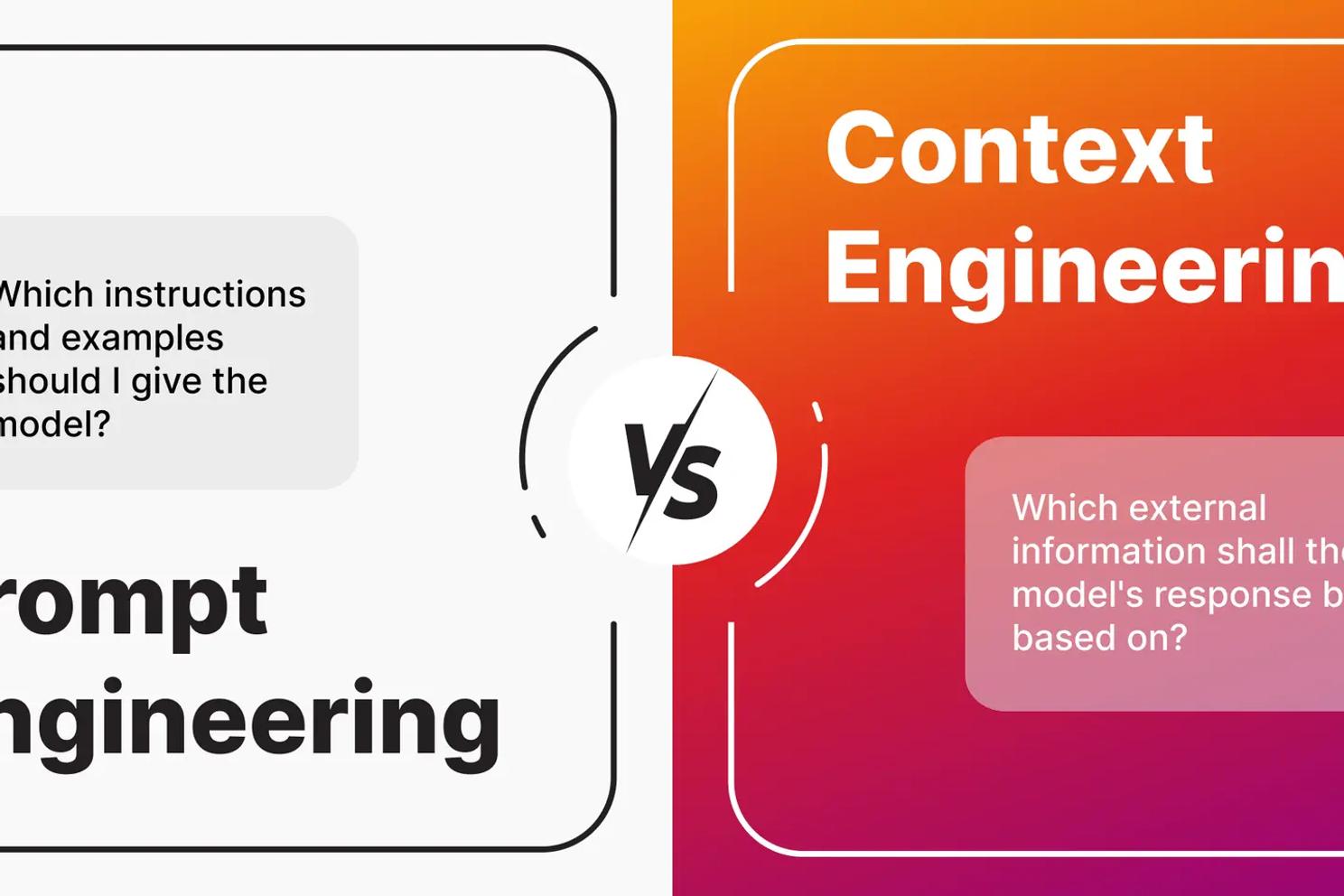
If prompt engineering is about what you say to the model, context engineering is about what information the model can see when it responds to you.
Every large language model has a context window — the amount of text it can process at once. Everything the model knows about your specific situation has to fit inside that window. It doesn't have memory of past conversations (unless you build one). It doesn't know what's in your database (unless you put it there). It doesn't know your company's policies, your user's history, or the document you're referencing (unless all of that is assembled and fed in before the model responds).
Context engineering is the discipline of designing those assembly systems: deciding what information gets retrieved, summarized, filtered, and structured before being passed to the model.
"Prompt engineering designs the instruction. Context engineering designs the information landscape the model sees when it reads that instruction."
These two disciplines are deeply intertwined. A well-written prompt inside a poorly assembled context produces bad outputs. A rich, well-curated context with a vague prompt is wasted. In production AI systems, they have to work together.
What Is RAG — And Where It Fits
Retrieval-Augmented Generation (RAG) is one of the most important practical applications of context engineering.
Here's the problem RAG solves: language models are trained on data up to a certain date, and they don't have access to your specific, private, or recent information. If you ask a general-purpose AI about your company's return policy, it can't answer — unless that policy is somehow included in the conversation.
RAG solves this by:
- Taking a user's question
- Searching a knowledge base (documents, databases, PDFs, wikis) for relevant chunks of information
- Assembling those chunks into the context window alongside the prompt
- Letting the model answer based on what was retrieved — not just what it was trained on
The result is an AI that can answer questions about your specific domain, documents, or database, without requiring expensive retraining.
From a prompt engineering perspective, RAG changes the game. The prompt is no longer just the user's question — it's the user's question plus a carefully structured block of retrieved context. Designing how that context is presented (what format, what order, how much, with what instructions about how to use it) becomes just as important as the question itself.
This is why practitioners now say: "Context engineering is what makes RAG work."
Prompt Engineering vs Context Engineering: A Practical Comparison
It helps to see these two disciplines side by side.
[@portabletext/react] Unknown block type "table", specify a component for it in the `components.types` prop
In most real-world AI applications, you're doing both simultaneously. You're writing a good system prompt and designing a retrieval pipeline that feeds the right documents into the context window before that prompt runs.
Is Prompt Engineering Dead?
A persistent claim in tech media is that prompt engineering is a "fad" and that increasingly capable models will make it obsolete.
This is mostly wrong — but it's wrong in an instructive way.
What's becoming less necessary: elaborate "jailbreak"-style prompts, the need for very precise phrasing for simple tasks, and tricks designed to work around model limitations that have since been fixed.
What's becoming more necessary: systematic prompt design for production systems, context engineering for knowledge-intensive applications, multi-step conversation architecture, structured output design, and testing/evaluation of prompts at scale.
The skill is shifting from writing a clever sentence to designing a reliable instruction system. That's not death — it's maturity. The equivalent transition happened with software engineering (from hobbyist code to professional systems design), with data science (from Excel magic to full data pipelines), and with UX design (from graphic taste to user research and information architecture).
"Prompt engineering isn't dead. It's been promoted. The tricks are fading; the systems thinking is rising."
Skills Required to Become a Prompt Engineer (in 2025)
The job title "prompt engineer" exists, but it's rapidly evolving toward something broader. Here's what the skill set actually looks like right now:
Clear written communication. This is non-negotiable. Prompt engineering is fundamentally about articulating goals, constraints, and context in language that a model can act on reliably. If you can write clearly for a human audience, you can learn to write well for AI.
Understanding of LLM behavior. You don't need to know the math. But you should understand how models handle context windows, why they hallucinate, how temperature and sampling affect outputs, and what system vs. user messages do. This mental model makes debugging much faster.
Basic programming (Python preferred). Almost all production prompt engineering involves API calls, loops, conditionals, and data handling. Python is the lingua franca of the AI tooling ecosystem.
Experimentation mindset. Prompts are hypotheses. You write one, test it, analyze failure cases, revise, and test again. People who are impatient with iteration tend to struggle here.
Domain knowledge. The most valuable prompt engineers deeply understand the domain they're working in — medicine, law, finance, software engineering, marketing — because they can catch model errors that a generalist wouldn't recognize.
Familiarity with retrieval and data systems. As context engineering becomes central, knowing how vector databases, embeddings, and search systems work becomes increasingly valuable, even at a conceptual level.
A Real-World Example: How These Layers Work Together
To make this concrete, here's a simplified version of how a well-built internal document Q&A system uses both prompt engineering and context engineering.
The user asks: "What's our company policy on reimbursing home office equipment?"
Context engineering layer:
- The user's question is converted into a vector embedding
- The system searches a vector database of company policy documents
- The top three most relevant document chunks are retrieved
- Those chunks are formatted and inserted into the context window
Prompt engineering layer:
- A system message instructs the model: "You are an HR assistant. Answer questions based only on the provided policy documents. If the answer is not found in the documents, say so explicitly. Do not guess or infer. Use clear, plain language."
- The retrieved chunks and the user's question are combined and passed to the model
The model responds with an accurate, grounded answer — citing specific policy language — rather than hallucinating a plausible-sounding but incorrect one.
Remove the context engineering layer (no retrieval), and the model either hallucinates an answer or says it doesn't know. Remove the prompt engineering layer (no system message), and the model might answer in the wrong tone, fail to acknowledge when it's uncertain, or ignore the retrieved documents in favor of its training data.
Both layers are required. Neither is optional.
Where Prompt Engineering Is Heading
The trajectory is fairly clear, even if the pace is uncertain.
Prompts are becoming code. More teams are storing prompts in version-controlled repositories, testing them like software, and treating changes as deployments. "Prompt drift" — where a prompt that worked last month stops working as well after a model update — is a real operational concern.
Evaluation is becoming a discipline. Knowing how to measure prompt quality at scale (not just eyeball a few outputs) is increasingly valuable. This involves building test sets, defining success metrics, and running automated evaluations.
Multi-agent systems are raising the stakes. When AI models coordinate with each other — one researching, one drafting, one reviewing — the prompts that govern each agent's behavior compound in complexity. Getting one wrong can break the whole pipeline.
The role is merging with AI product engineering. The cleanest career path for someone who's excellent at prompt and context engineering isn't "prompt engineer" — it's "AI product engineer," a role that combines system design, product thinking, and deep knowledge of how LLMs behave.
The Bottom Line
Prompt engineering started as a bag of tricks. It's becoming a craft — and then a discipline.
The beginner who learns to write a clear, structured prompt with role, task, format, and examples is already ahead of most casual AI users. The practitioner who then layers in context engineering, retrieval, multi-step conversation design, and systematic evaluation is operating at a level that translates directly into product value.
The transition from Prompt Engineering 1.0 to 2.0 isn't about learning more tricks. It's about developing a different way of thinking: from "how do I phrase this?" to "how do I design a system where AI consistently does what I actually need?"
That shift — from clever to reliable, from one-off to scalable, from instruction to system — is where the real leverage lives.
And if you're reading a beginner's guide to prompt engineering in 2025, you're arriving at exactly the right moment to learn it at the systems level from the start.